Rope Fighter Action Game
- 4.4
- Rating
- 10.00M
- Installs
- Free
- Price

 Analysis by App-foxy
Rope Fighter Action Game makes a quick first impression by putting movement at the center of its role-playing adventure. I found myself judging every encounter through the way the hero swings, closes distance, escapes danger, and then turns special powers into an opening for the next attack. That focus gives the game a clear identity: it is less about standing in one place and trading blows, and more about using the city as part of the fight.
The game comes from HitBox Games and is free to start, which makes it easy to try without committing money immediately. It is listed for Teen players, runs on Android 7.0 or later, and currently sits at version 5.6. Its average rating is 4.4 from around 17 thousand ratings, while the game has passed 10 million installs. Those figures suggest that the basic idea has found a sizeable audience, but they do not replace the more important question: does the swinging and fighting remain enjoyable after the novelty wears off?
How the city turns movement into the main attraction
My first sessions were driven by curiosity. The rope is not merely a decorative way to travel between missions; it changes how I approached space. A street, rooftop, or open stretch becomes a route rather than a background. I could think about where to go next, where an enemy might be waiting, and whether moving quickly would be safer than taking a direct path.
You May Also Like

 Blood Strike: 2.5 Anniversary
Blood Strike’s Loadouts Turn Every Drop Into a Tactical Gamble
A close look at Blood Strike’s custom loadouts: how fast access to signature weapons reshapes its battle royale rhythm, rewards preparation, and narrows the gap between fights.

 Pandora - Music & Podcasts
Pandora’s Music Is Easy to Start, but Harder to Recover
Pandora’s strength is its low-effort path from a seed to a station. Its weak spot is how much confidence it asks you to place in connection, setup, and quiet recovery.

 8 Ball Pool
 Is Built on Rivalries, Rematches, and Routine
A close look at the rivalries, rematches, shared routines, and unanswered safety questions that turn a quick pool match into a persistent mobile community.

 Samsung Music
’s Quiet Strength Is Playing What You Already Own
Its reach comes less from spectacle than from dependable access to a personal library. That simplicity is both the app’s strongest retention engine and its ceiling.

 AccuWeather: Weather Radar
AccuWeather Review: A Quick, Clear Forecast for Everyday Decisions
For everyday plans, the best forecast is the one you can understand quickly. AccuWeather makes rain timing, radar, and local conditions easy to act on, with a few trade-offs.

 Hill Climb Racing
Why Hill Climb Racing Still Turns Crashes Into One More Run
A tiny car, a bumpy hill and one more upgrade: Hill Climb Racing keeps resurfacing because its simple chaos makes every near-miss feel personal.
More From Our News Desk
View All News


That design gives the game an immediately readable fantasy. You are not simply controlling a fighter in a series of disconnected arenas. You are moving through a city while trying to preserve momentum. The best moments come when swinging, landing, attacking, and using a power feel like parts of one continuous decision rather than separate commands.
The opening appeal is especially strong for players who enjoy action games but want a lighter role-playing wrapper around them. The world-open structure gives the adventure a sense of freedom, while the combat keeps the objective understandable: reach the trouble, fight through it, and keep moving. I never felt lost because the central activity is always visible in the controls.
There is also a useful distinction between freedom and depth here. The city gives me room to experiment with movement, but that does not automatically make every trip equally interesting. If I was only travelling from one confrontation to another without trying a different route or approach, the open setting could feel more like connective tissue than a full activity of its own. The game works best when I treat movement as a skill to practise, not as an automatic shortcut.
A visual identity built around motion
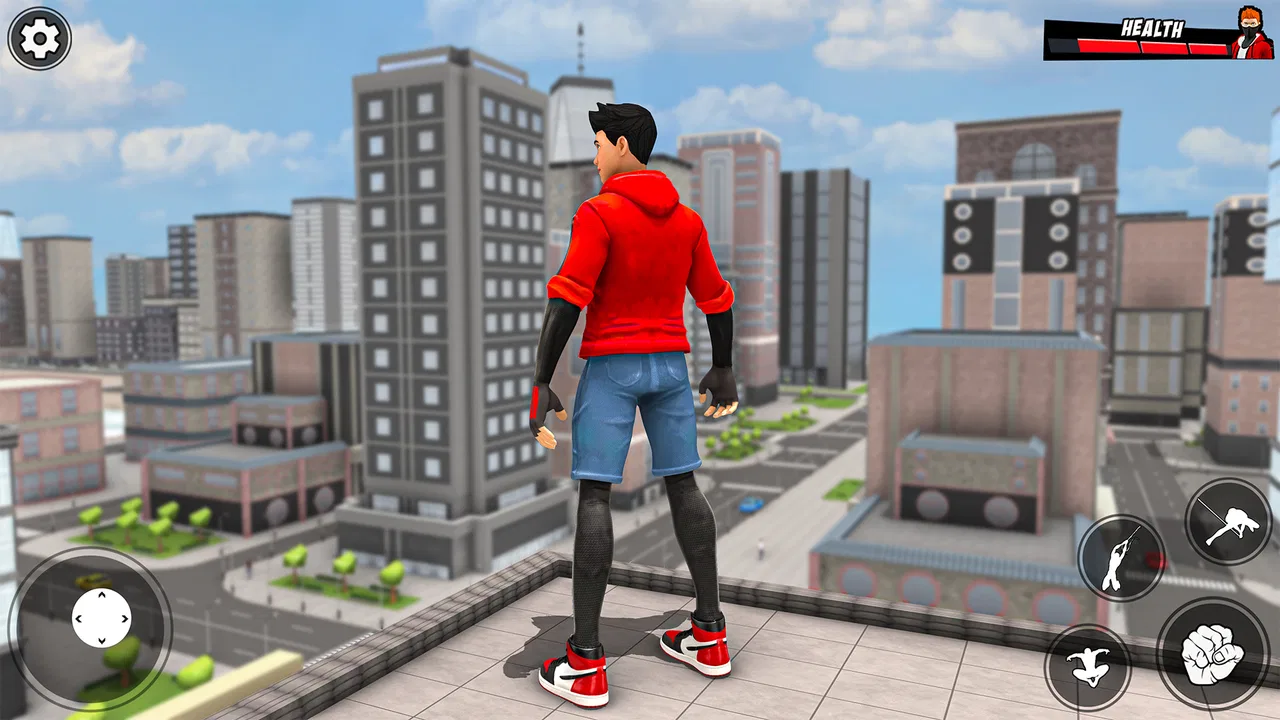
The art direction supports the fantasy by keeping attention on the hero’s silhouette, the rope’s path, and the immediate shape of the environment. I read the setting as a playground for vertical movement rather than a quiet place to admire at length. That is a sensible choice for this kind of adventure because visual clarity matters more during a fast swing than fine environmental detail.
What I liked most is the way the setting gives ordinary travel a dramatic purpose. Rooftops and streets are not just scenery between fights; they help establish the scale of the hero’s problem. When I move above the city, the game briefly shifts from brawler to traversal challenge. When I drop into a fight, the mood becomes more urgent and physical.
This visual language also makes the game approachable. I do not need to memorise a complicated world map to understand what the environment is doing. High and low routes, open spaces, and nearby targets communicate their usefulness quickly. That makes it a comfortable choice for short sessions, especially when I want immediate action rather than a long explanation of fictional history.
The trade-off is that players looking for a highly detailed role-playing world may find the presentation more functional than lavish. The setting exists primarily to support swinging and combat. If your ideal mobile RPG is built around deep dialogue, carefully layered lore, or a large collection of quiet activities, this is probably not the strongest match. Its atmosphere comes from movement and danger, not from slow world-building.
Why the sound matters more than expected
Sound has an important job in a movement-heavy game because it helps give actions weight. A swing should feel like a commitment, a landing should feel like a change of phase, and an attack should tell me whether I am still in control of the encounter. In my experience, the audio works best when it reinforces that rhythm instead of trying to dominate it.
The game’s mood depends on the contrast between travel and confrontation. Moving through the city creates a sense of anticipation, while combat compresses my attention into shorter decisions. That change in rhythm makes a familiar route feel different when I am rushing toward a fight or trying to create space after an attack.
I also found that sound can help compensate for the visual busyness that appears during active encounters. When several actions happen close together, audio cues make the sequence easier to follow. This is one reason I recommend playing with sound enabled when possible. The game is still playable silently, but the transition between swinging, landing, striking, and using powers feels flatter without that extra feedback.
The pacing is not built around long periods of quiet reflection. It is closer to a series of bursts: move, engage, react, recover, and move again. That can be refreshing when I have only a few minutes, but it may feel repetitive if I expect every mission to introduce a dramatically different mood. The atmosphere is coherent precisely because it stays focused, although that focus limits its emotional range.
Combat that rewards positioning before button pressing
The most useful habit I developed was to think about positioning before attacking. It is tempting to rush toward the nearest opponent and use powers immediately, especially when the game presents itself as a straightforward hero adventure. I got better results when I used the rope to change the angle of approach, landed with a purpose, and saved a power for the moment when an enemy’s position made it especially effective.
This is one of the game’s less obvious strengths. The rope can be treated as a defensive tool, not only a travel mechanic. Creating distance, reaching a better landing point, or avoiding a congested area can be more valuable than dealing damage at once. Players who focus only on attack buttons may finish encounters, but they miss much of what makes the movement system distinctive.
Another practical tip is to avoid treating every open space as an invitation to swing continuously. Sometimes a controlled landing is better than maintaining speed. I found that rushing can place the hero in an awkward position, especially when I have not considered what will happen immediately after landing. A short pause to read the area often produces a cleaner attack than a flashy but careless approach.
Powers are most satisfying when they extend the movement plan rather than interrupt it. I prefer using them to secure an opening, break a dangerous sequence, or finish an encounter after I have already created a favourable position. Using every ability as soon as it becomes available can make combat feel less deliberate and can remove the sense that I am solving the encounter.
That said, the action remains accessible. I do not need to play with perfect timing to understand the basic loop. This makes it suitable for players who enjoy the appearance of a superhero-style action game but do not want a demanding console-level combat system on a phone. The deeper challenge comes from improving routes and choices, not from mastering a huge command list.
Where the role-playing layer fits
As a role-playing game, it is best understood through progression and the feeling of becoming more capable, rather than through a heavily text-driven campaign. The adventure gives combat and powers a sense of purpose, but the moment-to-moment pleasure still comes from controlling the hero in the city.
This balance will suit players who want a clear action loop with some role-playing flavour. I can imagine opening it after work, completing a few objectives, and stopping before the session becomes a major time commitment. The city makes the game feel larger than a simple stage-based fighter, while the direct combat keeps the learning curve manageable.
It is less suitable for someone searching for a slow, character-focused RPG where conversations and choices carry as much weight as battles. The game’s identity is physical. Its strongest storytelling tool is what the hero does in the environment, not the amount of time spent reading or managing a large cast.
The free entry point is convenient, but players should remember that optional purchases range from $0.99 to $19.99 per item. I would recommend playing long enough to decide whether the movement loop itself is enjoyable before spending anything. Purchases make more sense for someone who already likes the core rhythm and wants to support or extend that experience; they are not a substitute for finding the basic controls satisfying.
Everyday use: a good short-session city escape
In a realistic everyday scenario, I would use this as a short break rather than as a game that demands a full evening. Suppose I have a bus ride or a waiting period and want something more active than a puzzle. I can enter the city, practise a route, handle a fight, and put the phone away without needing to reconstruct a complicated plot when I return.
For that use, I suggest giving the first few sessions to movement rather than rushing through objectives. Try approaching the same area from different heights, notice how much space is available after landing, and experiment with using a power only after repositioning. This turns the early game into a small training ground and helps reveal whether the rope system has enough appeal for you.
It is also a reasonable choice for younger teens who like heroic action but need an experience with a clear control idea. The Teen rating still matters, so parents should consider whether the game’s combat presentation suits the player. Adults who want a more complex RPG may instead prefer a title with deeper character management, longer-form quests, or a more substantial narrative structure.
How it compares with familiar mobile alternatives
Compared with a traditional mobile brawler, this game’s advantage is the city traversal. A conventional brawler may deliver tighter, more concentrated combat, but it usually cannot make travel feel like part of the fantasy. Here, swinging gives the player a reason to look at the environment and plan movement between encounters.
Compared with a large open-world RPG, the advantage is immediacy. There is less pressure to maintain a long list of systems before the action becomes enjoyable. The cost of that simplicity is breadth: players who expect extensive exploration, detailed character builds, or a world filled with unrelated activities may find the experience narrower.
It also sits apart from endless-runner games because the movement is connected to fighting and positioning rather than only avoiding obstacles. That makes the decisions more expressive, but it also means careless movement can create combat problems. I would choose this over an endless runner when I want my route through a space to affect an encounter, and choose the runner when I want a purer reflex challenge with less combat context.
For fans of superhero games, the comparison is similarly mixed. Rope Fighter delivers the appealing fantasy of travelling rapidly through a city and confronting threats with powers. It does not aim to replace a large premium adventure with cinematic storytelling and extensive content. Its strength is that it distils the fantasy into a mobile-friendly loop rather than reproducing every part of a major console experience.
Small frictions that affect the long-term mood
The same focus that makes the game easy to understand can also make its limitations noticeable. Once I knew the basic movement pattern, the question became whether the city and encounters would keep giving me fresh reasons to change my approach. Players who enjoy refining a familiar system may be happy with that arrangement. Players who need constant new mechanics may lose interest sooner.
The free-to-play structure is another point to consider. Even when I am enjoying the action, the presence of optional purchases can change how I evaluate progression. I prefer to decide on spending based on enjoyment rather than impatience. If a player dislikes in-app purchases in general, the game may create friction regardless of how good the swinging feels.
There is also a pacing trade-off. Fast movement and frequent action make the game convenient, but they leave less room for atmosphere to develop slowly. The city feels energetic and playable, not mysterious or contemplative. That is a strength during short sessions and a weakness if you want a world that rewards simply wandering around.
Performance expectations should be kept practical. The minimum Android requirement is 7.0, which places the game within reach of many older devices, but compatibility alone does not guarantee that every phone will deliver the same comfort during busy action. I would close other demanding apps, keep enough free storage for normal updates, and test the controls on the device I actually plan to use before deciding whether it feels responsive enough.
Who should play it and who should pass
I recommend it to players who want a free role-playing action game with a strong movement hook, clear heroic energy, and sessions that can begin quickly. It is particularly appealing if you enjoy experimenting with routes, using the environment to approach fights, and turning traversal into part of the combat plan.
I would be more cautious about recommending it to players whose priorities are deep narrative, elaborate character builds, or a constantly expanding range of activities. The game’s pleasure comes from doing a focused set of things well. If you need a mobile RPG to function as a complete second life, this will probably feel too concentrated.
My best advice is to judge it in two stages. First, ask whether swinging through the city remains enjoyable when there is no immediate reward attached to it. Second, ask whether you like planning an attack around position instead of simply pressing the strongest move. If both answers are yes, the game has a solid chance of holding your attention. If either answer is no, the surrounding role-playing framing is unlikely to overcome that mismatch.
The final atmosphere verdict
Rope Fighter succeeds because its art direction, sound, setting, and pacing all point toward the same playable mood: quick movement through a dangerous city, followed by bursts of close action and power-driven momentum. Nothing feels completely detached from that central idea. The presentation is there to make traversal exciting, and the mechanics give the atmosphere something concrete to express.
My favourite part is the way the rope changes the meaning of distance. It encourages me to look beyond the opponent directly in front of me and consider the space around the fight. That single idea gives the game more personality than a standard mobile fighter, even though the overall structure remains approachable.
The experience is not a perfect replacement for a deep open-world RPG or a highly technical action game. It is more focused, more convenient, and more dependent on whether its movement loop clicks with you. The optional purchases, concentrated content style, and limited emotional range are worth keeping in mind.
Still, I think it is worth trying for anyone who wants a free hero adventure built around swinging, fighting, and powers rather than menus and long explanations. The key decision is simple: if movement feels like part of the fun to you, the city becomes a combat tool instead of a backdrop. That is where the game’s atmosphere becomes convincing, and where HitBox Games gives this compact action RPG its clearest reason to exist.
FAQs for Rope Fighter Action Game
01What is Rope Fighter Action Game about?
Rope Fighter Action Game is an exciting mobile game where players take on the role of a superhero with unique rope-swinging abilities. The game combines action-packed combat with strategic gameplay as players navigate through various levels, battling enemies and overcoming obstacles. It offers an immersive experience with stunning graphics and intuitive controls.
02Is Rope Fighter Action Game free to play?
Yes, Rope Fighter Action Game is free to download and play on both Android and iOS platforms. However, it includes in-app purchases that allow players to buy additional items, power-ups, and cosmetic upgrades. These purchases are optional and not necessary to enjoy the full experience of the game.
03What are the key features of Rope Fighter Action Game?
The game includes several key features such as dynamic rope-swinging mechanics, a variety of challenging levels, and engaging combat scenarios. Players can customize their characters with different skins and upgrades. Additionally, the game offers regular updates with new content, ensuring a fresh experience for returning players.
04What are the system requirements for Rope Fighter Action Game?
For Android users, the game requires Android 5.0 or higher, while iOS users need iOS 10.0 or later. The game is optimized for both smartphones and tablets, ensuring smooth performance across devices. Players should ensure they have sufficient storage space and a stable internet connection for the best experience.
05Does Rope Fighter Action Game require an internet connection?
Rope Fighter Action Game can be played offline, allowing players to enjoy the game without an internet connection. However, certain features, such as leaderboards and in-app purchases, require an online connection. Playing online also ensures access to the latest updates and events.
Pros
- Engaging storyline with dynamic missions.
- Intuitive controls for smooth gameplay.
- High-quality graphics enhancing the experience.
- Variety of weapons and skills available.
- Regular updates with new content.
Cons
- In-app purchases can be costly.
- Occasional lag on older devices.
- Requires constant internet connection.
- Limited customization options for characters.
- Battery consumption is relatively high.

Rope Fighter Action Game
Gallery